I occasionally share updates and trivia from the court, along with public comments from Taiwanese legal scholars on cases and court business. If you like it, I hope you consider sharing it.
I stopped updating for almost half a year—not only because of my terrible time management, but also because the TCC is officially dysfunctional after the Constitutional Procedural Act Amendment (CPAA) was passed.
In this post, I want to summarize how the constitutional court has handled the amendment challenges recently. It’s been… interesting.
***
The TCC’s Puzzling Moves
February 10, 2025: Shutting Out the Little Guy
The TCC’s second chamber dismissed a petition challenging the constitutionality of the CPAA amendment. The case was brought by a citizen petitioner—actually an alcohol company—arguing that the amendment shut down the court, preventing timely resolution of their previous case about compelled speech on wine labels violating freedom of speech. Their original petition had been granted certiorari back on June 2, 2023, and it’s still sitting in the docket.
The chamber dismissed the case with three reasons that are, frankly, quite unreasonable:
- The CPAA isn’t the law applied in lower courts
- The petitioner didn’t exhaust all legal remedies against the amendment
- The petition was filed too late—beyond the required 6-month deadline after receiving the lower court decision
This strict application of the law is completely different from how they’ve applied it before. What this decision really conveys is that this type of case can never be brought by ordinary people. Since constitutional procedural acts are never within the jurisdiction of regular courts, it’s completely unrealistic to fulfill the requirements the TCC is demanding.
May 14, 2025: But Politicians? Sure, Come On In
Out of surprise, the TCC decided to hear the constitutionality of the CPAA on May 14, 2025. This case, different from the dismissed petition, was filed by Democratic Progressive Party legislators in parliament. The decision came after an informal meeting between justices, petitioners, and experts on April 18. Unlike oral arguments, informal meetings are a procedural device for the TCC to gather necessary information.
However, until now, the TCC hasn’t done anything after deciding to hear the case.
Why Politicizes the Court?
In my opinion, the TCC’s decision-making is quite unwise if they really want to hear this case. By hearing it as a conflict between political parties instead of on the first occasion with the citizen petition, the TCC has stepped into the deep waters of political conflict. Neither a constitutional nor unconstitutional decision can help the court escape criticism—they’ll be called a party-manipulated puppet either way.
The choice the court needs to make isn’t just about legal acquiescence or self-protection. They need to consider public criticism too.
Similar to other apex courts worldwide, “the judiciary can impose constitutional constraints on powerful political actors only if these actors support the judiciary—either because the public does or the politicians themselves do (Bradley & Siegel, 2025).” The current parliamentary majority is obviously not allied with the TCC, and the public, after the failed recall efforts, isn’t either. This is why I think intervening in this case through political conflict is unwise. No matter what the legal arguments are, it looks like the TCC need to chose a camp to join. It’s bad for judicial trust and even worse for restoring the TCC’s authority.
***
Recent Political Drama
July 25: Nobody Gets Confirmed
Parliament exercised their confirmation power on new TCC justice candidates nominated by President Lai Ching-te in the second round. None was confirmed as the first time. The KMT and TPP alliance didn’t confirm any justice candidates, but surprisingly, the DPP didn’t confirm all the justices either. Two candidates—law professors Chan Chen-jung and Chen Tzu-yang—received only 26 out of 56 DPP votes.
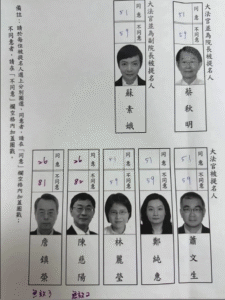
While there’s no official explanation, my reading is that most legislators still see justice candidates as their potential promoters in the court. For example, these two professors revealed more reserved views toward policies promoted by the KMT and TPP alliance.
July 26: The Great Recall That Wasn’t
The citizen-initiated, DPP-supported “great recall” failed to unseat any legislators in parliament. If I remember correctly, this recall was initiated by the Economic Democracy Union, an NGO established during the 2014 Sunflower Student Movement. They came up with this political strategy after several legal strategies failed—like requiring the president to unpublish the law or dissolve parliament.
The DPP didn’t initiate the great recall but joined the movement after most recall requirements were fulfilled. Within the recall movement, it was framed as the only way to secure Taiwan by unseating pro-China legislators. However, this didn’t persuade most voters.

Leave a Reply